Saturday, March 17, 2007

Update from Orlando, and excitement about Kierkegaard

My time here in Orlando is nearing its end. (As a side note, while it is 26 degrees and snowy in northeast Ohio, it will be 70 degrees and sunny when I go to Clearwater Beach tomorrow to see my first sunset over the Gulf!) I had intended to download some pictures and blog about my experiences, but despite paying $10 for 24 hours of Internet, I am simply too tired to do so.

I finished my most recent read, "Philosophy and Theology" by John D. Caputo, and I hope to share some things from that book, as well as "Who's Afraid of Postmodernism?" But both have piqued my interest in Soren Kierkegaard, a 19th Century Danish philosopher. He and Nietzsche represent two early starting points for postmodern thought (the former the religious, the later the secularist), at least according to Caputo. In any case, I bought a book today to start reading on the way home. It is "The Cambridge Companion to Kierkegaard." I have not started it, but the introduction page certainly makes me excited to read more:

Few thinkers have been so consistently misunderstood as Soren Kierkegaard (1813-1855). Amongst the many myths that have attached themselves to his work is the belief that Kierkegaard was an irrationalist who denied the value of clear and honest thinking. The truth is that Kierkegaard did deny the power of reason to uncover universal and objective truth in matters of value, but in the current philosophical climate there is nothing irrational about that.

The contributors to this companion probe the full depth of Kierkegaard's thought, revealing its distinctive subtlety. The topics covered include Kierkegaard's views on art and religion, ethics and psychology, theology and politics, and knowledge and virtue. Much attention is devoted to the pervasive influence of Kierkegaard on twentieth-century philosophy and theology.

I know, I know, far too exciting for most people to read... But I think that the above summary of Kierkegaard's thrust is a great starting point for describing Postmodernism, or at least Postmodern thinking.

Monday, March 12, 2007

Continued (though lessened) Raw Frustration

For background to this post, please see the previous post.

Issue #3: The importance, roles, and dangers of investing authority.

As we consider the shape and direction of our local Body of Christ, the issue of authority is front and center. It never seemed to be an issue when there were only 8 or so of us. Now that we regularly have 16-20 people, it is much more of an issue. It became obvious to me when a friend and I were discussing how to define ourselves before we are defined from the outside. Right now, the core has a sense of what we are about and what we value. We share much of that in common. But if several people were to come into the community who are not familiar with those values and sense of direction, no one would have the authority (as it stands right now) to share with these new community members what our values are. Several could go up to them and share individually, but no one has explicit authority to represent the group.

For example, and to revisit the previous post, say a few people decide that they value a "Purpose Driven Church" model, and they start pushing for everyone to go along with this idea (speaking from experience, Jared and I tried this with the group of about 6 others, and it failed miserably... because it was not in line with our values nor our strengths). I could go up to one of them and say, "You know, I don't think this idea will work for this group. I don't think it is in line with our values, and I'm certainly not comfortable with it." They may or may not take it to heart. But that has a very different impact than someone who has authority vested in them from the group coming up to them and saying in love, "We appreciate the idea, but this isn't building on our group's strengths. It is not in line with our values. These are our values... "

In other words, "authority" or "leadership" has a very important role that I never really appreciated: Protection. Explicitly recognized leaders have vested authority to protect the values, goals, and intentions of the community.

But there is still the little problem of having someone speak for everyone. It is really only a modern problem, where everyone feels (rightly?) entitled to their voice and opinion. What if the leader says or does something that you don't agree with? Humility and submission are part of the equation, no doubt (from a Biblical standpoint), as 1 Peter and Hebrews 13 make clear. But what do those passages mean in today's context?

I can imagine several responses to this whole vein of thinking, largely based on personality and background. To those who grew up in authoritarian churches, where individuals had little or no real voice (and therefore power), two reactions are likely. Those who feel safe and function well in those environments (think SJs for you Meyers-Briggs aficionados) will likely wonder what all the hubbub is about. "Of course you need leaders!" For those who have been hurt in such churches, or who are more independent of mind and spirit (SPs and NTs), there is a tendency to be more egalitarian by nature, and would be resistant to repeating "mistakes" of the past. Power trips and egos seem to go with most "leaders" and also division. To those who grew up in very loose, egalitarian churches, this may seem like backsliding and promotion of division, since strong leadership tends to bring clarity of differences, not similarities. But, there are likely some from that background who would like to stand for something, and know that the community will stand with them. Leadership can provide that unifying force of focus.

Let me make this clear, lest any missed this in my posts: I'm very aware of the New Testament passages on authority. I grew up in a background that not only values authority, but Bible study and memorization (one of the many things I'm very grateful for). So I'm familiar with all the traditional (Church of Christ) arguments and logic for understanding authority. I have not forgotten these things. Notice, however, that I did not say that I know what the Bible says about authority and leadership. I am no longer confident in my understanding of what the Bible says to us today. I can confidently state what it said to the people of the 1st century, but even then I fear presumptuousness if I say that I know what it meant to the people of the 1st century.

All that to say that these issues are not as clear cut and black and white as they were for me in the past. Some will lament, others rejoice. I can do neither; those actions require grounds for making value judgments. I'm in the thick of it, with no place to look down from and make such judgments.

But Christ is faithful, and I know He loves me, and that this journey will grow my dependence on Him for clarification and perspective. Amen.

Thursday, March 08, 2007

A (Rather Long) Moment of Raw Frustration

I was visiting with a couple from our house church tonight, and had some very deep, answerless, challenging discussions. I just have to take a moment and share some raw thoughts about one of the topics. There are no values placed on these statements… just pure frustration and emotion.


Authority. Legitimacy. Ideas and concepts that Jared has been wrestling with on his blog. Tonight, some of the reasons for the difficulty these concepts pose to me came to light. However, having light shine on a problem does not always guarantee quick resolution of the problem.


Issue #1: Systems always have unintended consequences, and there is no escaping a system. For example, we were talking about two different approaches to “operating” a faith community, for lack of a better word. One is a more egalitarian, fluid, organic, and, my default, democratic way of functioning (let’s call it the Democratic Model). People share their views, and the community discusses things and decides on activities more democratically. This allows diverse spiritual and theological views to remain (since it is more activities than beliefs that are concretely decided in a (default) democratic way). Another system in some way codifies a group’s values and actions, defining itself early on and allowing others to accept and co-exist or decline and not engage a particular group (let’s call it the Constitutional Model).


Why this issue? Because as a group, we have tremendously strong relationships and connections with strong spiritual focus. This has led to the happy yet troubling problem of growth. Issues weren’t really issues when you have only six or seven adults with the same background. It becomes more challenging with 15 adults with very different backgrounds.


So practically, what does this issue mean on the ground, for us in our home church? Everyone is a part of our church for some reason; everyone sees something they value in the group. It may be the freedom to grow and stretch spiritually, or the intimacy and love of the relationships, or it may be the simple fulfillment of friendship needs, or it may be the non-institutional, non-building oriented nature of the church. But as the group grows, the diversity of values (what is important to people) shift. So, if we take a more Democratic Model, as more voices add to the decision making process, the values that drew the initial core may change from being the majority to the minority. Then you are faced with the dilemma of staying where you no longer fit in or where your values are no longer guiding the actions of the group, or leaving the bonds of love and desires of unity to find a group more like-minded (birds of a feather, flock together). If a Constitutional Model is used, there would be an explicit shaping of the group, which might keep some away, and cause accusations of trying to be different, unique, and/or divisive, or the possibility of “rule by the minority” based on this codification of self-concept at a static point in time.


Ahhhhhh! Can you feel the frustration (confusion?) as your head spins?

So, being more concrete, let’s give a real possible question. Let’s assume for now that we have 15 adults, 9 of which don’t want to ever have a building, 2 of which would prefer a building, and 4 who don’t really care either way. We decide tomorrow that we are going to follow a Democratic Model. Let’s say that 8 more people join our group, and that they all happen to be open to having a building, and in fact, would like to work towards that. Now, the majority value of the group is to work towards a building (10), while 9 people think a building would destroy the very nature of the group. In a Democratic Model, the majority would win, and the new minority must decide if they should restart a group that has no plans to pursue a building, or stay where their values are no longer promoted as directly. If they did leave, then ultimately they would be assuming a default Constitutional Model by valuing this belief more than the voice of the majority, and in forming another group with that common belief, have an unofficial (non-explicit) constitution. But, if the group adopted a form of common framework that stated this group values being free from the burdens and financial drain of buildings and values the authenticity that meeting in homes allows, then as it grew, people would know that this is what this particular group believes, and if that doesn’t fit with the new person’s values, then they wouldn’t join. This model comes across judgmental, authoritarian, and divisive, at least to many. It might slow and prevent growth, but it may also slow or prevent later division.


What is better? What is right? What has more weight of tradition? What has more Biblical weight? My brain is frying!


Issue #2: Deciding a system is immensely more difficult than criticizing a system. It has always been easier to find fault in a system that I did not create nor approve of. I feel the weight of this decision, and it makes me want to run away, or abdicate. However, no decision is in fact a vote for the default, whatever that may be where you are. For us, that would be more of a Democratic Model. And at this point, I have as much say in a decision as anyone else.


Oh there is more. Much more. But this is way too long as it is. A glimpse into the future:


Issue #3: The importance, role, and dangers of investing authority.

An "About Me" Update

Although most people who see this blog are my close friends, I thought it would be a good time to just give a little “About Me” update. In any case, it will be interesting to look back at it in 5 years and see where I was and what I liked.

Birth Place: Born and raised in Arizona.

College: Grand Canyon University, Phoenix, Arizona

Med School: A.T. Still University of Health Sciences (ATSU): The Kirksville College of Osteopathic Medicine, in Kirksville, Missouri

Out-of-Country Travel:
1. Victoria, BC for a day trip.
2. Corozal, Belize, in Central America for four weeks, learning about missionary work.
3. Aasenfjord and Oslo, Norway, for seven weeks in high school with a program called Youth for Understanding.

Some places I’ve spent time at:
1. Chattanooga/northern Georgia
2. NYC
3. Philadelphia, PA
4. Washington, DC
4. Boston/northern Massachusetts
5. Vermont/New Hampshire/southern Maine
6. Miami Beach, FL
7. New Orleans, LA
8. St. Louis, Kansas City, and Columbia, Missouri
9. Chicago, IL
10. Nashville, TN
11. Albuquerque and Las Cruces, NM
12. Houston, San Antonio, Austin, Fort Worth, TX
13. Las Vegas, NV
14. Colorado Springs, CO
15. San Diego, Los Angeles, and San Francisco, CA
16. Detroit and Grand Rapids, MI
17. Port Angeles/Puget Sound/Seattle, WA
18. Lewisburg, WV
19. Minneapolis, MN
20. Arizona
21. Ohio.

Personality Type: (Myers-Briggs) ENTP

Career: Out Patient Only Family Practice

Siblings: One sister, plus a brother-in-law and a nephew

Favorite Games:
1. Settlers of Catan (Cities and Knights)
2. Taboo/Catch Phrase
3. Trivial Pursuit
4. Magic, the Gathering Card Game

Favorite TV shows:
1. Battlestar Galactica (new series)
2. Lost
3. My Name is Earl
4. The Office
5. Scrubs (way too close to home… very hilarious)

Favorite Sports:
1. Ultimate Frisbee
2. Racquetball
3. Tennis

Church:
1. Home Church. We meet in either my home or a friend's home, depending on the weather.
2. I will visit Wide Eyed Life, a new community within First Christian Church of Canton.

Spiritual Background: I grew up in the non-instrumental Churches of Christ.

Favorite cities I’ve been to:
1. Seattle, WA (love it!)
2. San Fransisco (too bad there are so many earthquakes!)
3. Boston (awesome history!)
4. Austin (cool, laid back city)

Least favorite cities I’ve been to:
1. New Orleans (the REAL Sin City)
2. NYC (lots to do, but little greenery)
3. Albuquerque (not much goin’ on there)

Most beautiful places I’ve been:
1. Puget Sound area of Washington (perfect combo of cool weather, mountains, and water!)
2. Sedona, Arizona (Red Rock Country)
3. The Grand Canyon (need I say more?)
4. Norway (very similar to Washington)
5. Holmes County, Ohio (Amish Country… beautiful rolling hills, woods, and farms)

Friday, February 23, 2007

Armpit Jesus (and other insights from the stories we tell ourselves)

I was at a Bible study last night, and a father of two young children was sharing some thoughts about celebration in Christianity. In the process, he shared a couple of stories about his 3 or 4 year old daughter, and that triggered a remembrance of another story. All three stories about young children’s thought formation about Jesus and God are extremely revealing of our Christian culture.

I remember one couple sharing their amusement and slight chagrin about the fact that their young son was absolutely terrified of Jesus. When asked why, the boy explained that he was afraid that Jesus was going to sneak in to the house at night and take him away, since Jesus was “everywhere” and “could go anywhere” and actually knew who the boy was, even though he was invisible. That phase lasted a little too long for his parents’ comfort

Last night, two similar stories were shared. His (three year old) daughter went through a phase where every time Jesus was mentioned, she would get angry, and she would say she was mad at Jesus and didn’t like him. “Really? Why?” asked her parents. “Because I have asked Jesus to come and live with me and he hasn’t.” (How can you argue with that?)

Later, his daughter went through a phase where she refused to talk about allowing Jesus into her heart. She didn’t like him, and didn’t want him in her heart. One day, the speaker came home and his wife excitedly told him that his daughter had made great progress. “Has she asked Jesus into her heart?” he asked hopefully. “No. But she has decided that he can live in her armpit.”

Though very amusing, these stories tell us a lot about how we adults think and believe. Can we blame children for their naïve assumptions? Though stories like these abound, I have never heard of a child seeing an act of service by someone, and asking if that person was Jesus. Children can’t see Jesus except in us. Explaining to young children that Jesus loves everyone, including a little child, needs to be done with actions, not words.

More than my child saying that they love Jesus (which is too abstract for very young children and even some adults), I hope that any of my future children, when they are young, will say that they want to be like Jesus, and act like it too.

Thursday, February 01, 2007

Authority, Culture, and Tradition

There is a rather interesting discussion that my best friend Jared Coleman has started on his blog. The particular blog entry regards authority. The questions he raises are foreign and incomprehensible to many people from a traditional Christian background. You can not generate questions to analyze issues one has never conceived of before. That is why many will not understand the question, much less try to answer it.

I have thought of these very same questions that he raises. Because my particular spiritual background holds a self-conception of being the "New Testament church," I have at various times sought connection (and authority, by extension) to the early church. While doing my undergraduate work at Grand Canyon University, (a Southern Baptist college at the time), I took advantage of the expanded religious section at our university library and read about the "Ante-Nicene Fathers" as well as read some of their writings.

While I can't possibly begin to answer the questions that Jared poses, simply because I barely have enough foundational knowledge to begin such musings, something has been whirling in my head. I have been pondering the nature of the relationship between authority (legitimacy), culture, and tradition.

As you begin to pose challenging and exciting questions like Jared and Scott, it becomes difficult to tease out what is God's intention (Did God intend for there to be a physical, unified church?) and what is the result of the cultural interpretation of the Word (and the word), or even interpretations founded entirely on tradition. The early church (starting around 100 C.E.) apparently was organized with each church (congregation? city?) having one bishop, a board of elders (called the presbytery), and deacons. Authority and/or legitimization was established by the laying on of hands. To some extent, many feel that these early leaders were the "spiritual" inheritors of the apostles' teachings and authority. The implication is that orthodoxy was maintained by having a visible "seal of approval" by the laying on of hands by those with the most "knowledge" of these teachings and traditions.

Where am I going with this? I don't even know for sure. But I wonder, was this "chain of authority" inherent to God's design and plan, or inherent to the culture or traditions of those people? At that time, the written word was not available. All teachings were oral, with some letters sent around the Empire with brief references to widely held doctrine. It would have been culturally vital to show which individuals had been "taught" and which had not by something such as the laying on of hands. But does this cultural necessity require us to view it as God's intention?

This become more relevant as we apply this thinking and reasoning to other issues very similarly related. (Keep in mind, I am not taking a position; I'm just exploring ideas and toying with concepts.) Take, for example, the role and status of women. There is a very strong tradition codified with much authority, that keeps women out of direct spiritual leadership in the church. There seem to be some very direct "biblical" statements on this issue generating a view that the early church fathers certainly embraced. If we accept that authority and church structure can be passed down, doesn't that imply that such codified teaching should be too? Were those statements, and views, set contextually in that society, or set as inherent views of humanity?

Of course, there are other issues, and I'm still chewing on it. I look forward to seeing the discussion develop further.

Sunday, January 28, 2007

Letting the Light Shine

Today I had the opportunity of worshipping with an emerging church plant called The Center. It was great getting to know new people with similar hearts.

The leader shared some thoughts from John 12:44-50. He focused on verse 46: "I have come into the world as a light, so that no one who believes in me should stay in darkness" (NIV).

First of all, I find this a very powerful proclamation of Jesus declaring himself to be the Messiah. In Isaiah 49:6, referring to His Messiah, God states, "It is too small a thing for you to be my servant to restore the tribes of Jacob and bring back those of Israel I have kept. I will also make you a light for the Gentiles, that you may bring my salvation to the ends of the earth" (NIV). This statement would have induced quite a bit of fervor among the crowd. This description of the Messiah was well known to the Jews of Jesus' day.

But that is a side note. In the discussion, we talked about how darkness is not an entity unto itself. It is simply the absence of light. We talked about letting that light shine into all corners of our lives. And then the pastor asked the question, "What does it mean to give things over to Jesus?" (roughly paraphrased). It got me thinking. It is not enough just to turn on the light to see the problems, make a list of things to do, and start the process of cleaning. Those areas don't just need to be "cleaned" in the Light; they need to be inhabited with faithful actions. A parable that Jesus tells comes to mind, from Luke 11:24-26 (NIV):
24"When an evil spirit comes out of a man, it goes through arid places seeking rest and does not find it. Then it says, 'I will return to the house I left.' 25When it arrives, it finds the house swept clean and put in order. 26Then it goes and takes seven other spirits more wicked than itself, and they go in and live there. And the final condition of that man is worse than the first."
I think The Message gives a good idea of the gist of the statement:
"When a corrupting spirit is expelled from someone, it drifts along through the desert looking for an oasis, some unsuspecting soul it can bedevil. When it doesn't find anyone, it says, 'I'll go back to my old haunt.' On return, it finds the person swept and dusted, but vacant. It then runs out and rounds up seven other spirits dirtier than itself and they all move in, whooping it up. That person ends up far worse than if he'd never gotten cleaned up in the first place."
Vacant. I like how The Message phrases that. Our lives can be as "clean" as can be, but if it is vacant, if we are not letting the Spirit inhabit every part of our lives, there is still an absence of light, and more evil can sneak back. In fact, having one problem is better than getting rid of the problem, cleaning up an area of life, and then still leaving it free of God.

To me, giving something over to Jesus doesn't just mean letting the light shine onto the dark corners so that I can see them to clean them. It means cleaning it up and letting Jesus dwell there. How? I don't know. By putting prayer prominently in the newly cleaned area? Changing language? Changing routines? Beginning new actions in that area? I have much to meditate on.

Saturday, January 27, 2007

35 Years of Marriage


January 6, 2007

Well, as promised, here are just a few pictures from my parent's 35th Anniversary Wedding Vow Renewal Ceremony. They never had a real "wedding" or wedding pictures. They do now. It was a surprise for my mom from my sister and me. (My mom kind of figured something like this was going to renewal. For those who haven't read the previous post about this, my parents eloped to Alaska (where my dad was stationed in the Army) and got married at a Justice of the Peace.happen, as she obviously got the wedding dress.)

The day was perfect. It really was. God provided a beautiful, sunny Arizona day.

My parents met at a Phoenix College football game in October of 1971. My mom was in the Marching Band, and my dad was visiting his dad in Phoenix (he was on leave from the Army, stationed in Alaska). They dated for a week, and then wrote to each other for 2-3 months. Then, in early January of 1972, my mom boarded her first ever plane and flew to Alaska to marry my dad. (She had a picture of him in her hand as she got off the plane, as she had only seen him a few time a few months earlier. If any of you know my mom, you know that she is very creative and loves helping with weddings. That is why this was so special. She finally got the wedding she never had.

Mom and Dad, you are incredible. It has been rough, for all of us, but you stuck it out. May you have many more years of love and life together.

Love you,
Tony

Friday, January 26, 2007

Emerging Leadership and Nomenclature: Part 3

Leadership Nomenclature

The confusing state of emerging church/spiritual leadership that I have previously addressed is seen in the nomenclature used to refer to different leadership positions and functions. As already mentioned, Solomon's Porch has a "Leadership Co-Op," with elected, rotating members. The term "co-op" has a more egalitarian and postmodern sound than a "board of directors" (which sounds thoroughly corporate-model). Yet, they also have a "lead pastor" who is always in the Leadership Co-Op. Almost all churches, emerging or not, have a "lead pastor" who is the real or figurehead leader. This term is still embraced by many, if not most, emerging churches. Other churches have leadership teams, but always a lead pastor. By definition, that term means that that person is in front, seeing the terrain, and blazing the spiritual trail for the rest to follow. (Senior Pastor is also used, emphasizing authority from experience and wisdom, but the same criticism still applies.) These "lead pastors" are the primary voice in that community. Otherwise, again by definition, they would not be lead pastors.

I have blogged before about the very term "pastor," and therefore will not repeat the thoughts from there. But it is interesting that we still don't have many new (and more accurate?) names of our leadership positions. There are some churches who look back to the ancient order and draw upon that deep well. On one site, the leadership link was titled "Elders." This is a very ancient and well-known term that implies a great deal. I had respect for an emerging church that would use such terminology for its leadership positions. When I clicked on the link, their "elders" were the lead pastor and the worship leader. From their pictures and bios, both were likely between 26-34. Hardly congruent with the term "elder." The ironic thing is that the New Covenant writings are filled with synonyms for elder that don't have such obvious implications, such as shepherds or bishops. Yet these are not used (again, very limited sample size, admittedly).

I don't have any answers, or suggestions. But nomenclature means something. What most people in modern churches think of as "pastors" are usually gifted teachers, or proclaimers, or even "prophetic voices" turning the hearts of God's people back to Him. Wouldn't it be wonderful to have a pastoral co-op? With rotating voices? Or shepherds who actually guard and tend the flock, who know each by name, and attend to the wounded, rather than fix budgets and hire staff? What could this body of leaders be referred to that would accurately reflect what they do, while also shaping their actions?

I don't mean to pick on anyone or any church. I bring out this state of nomenclature to identify a lag between emergent thinking and emerging church structures. I certainly have more to contemplate, and will be more aware of what our labels, or lack thereof, say about our communities.

Thursday, January 25, 2007

Emeging Leadership and Nomenclature: Part 2

Emerging Leadership?

Previously, I briefly reviewed my understanding of how leadership has evolved through the centuries. As I examine leadership in the era of change from a modern mindset to a postmodern one (whatever that means), it seems that little is changing.

When I explore what leadership actually looks like in emerging churches, I get a very modern picture of leadership. (Please note: When I say "explore" I usually mean by engaging a church's website, which is far from an accurate picture, but I still believe that much can be learned about leadership in how it is presented.) Some churches, such as Imago Dei, have a board of elders that includes all the pastoral staff, and a board of directors (program directors, I presume). At Solomon's Porch, there are dedicated staff members and a Leadership Co-Op (with the senior pastor always being a member) composed of members that are elected for two year terms, with only two consecutive terms permitted. From the description, the Leadership Co-Op acts like a board of directors of a corporation, hiring and firing, and overseeing the budget while putting out communal fires. Jacob's Well is apparently similar.

What is my point? I don't know. (Thinking out loud here, remember!) I guess when I look at all these emerging churches, I expect to see new, emerging forms of leadership. Instead, the structures remain the same, there is just more diversity of people. All these churches have a lead pastor. Essentially, it seems the leadership structure is still very modern, with one primary voice and the corporate board of directors dealing with the budget and "big issues." Why are there no co-pastors? Is there something inherent to spiritual leadership that demands only one prominent voice? Or is it that our structures have not caught up to emerging rhetoric?

In our house church, we have no official leaders. Jared and I step up to the plate with our natural leadership abilities frequently, but each is often not able to accomplish what we would like or envision, simply because the community doesn't want to or has another idea. Jared is the "prophetic voice" so to speak, so he is often viewed by visitors as the pastor, but that is likely to change as we recently decided to try some different approaches, getting even more people involved with feeding and leading thoughts. But we have had our share of challenges in terms of decision making as a community. And there are small, practical issues every once in a while.

So maybe the one-voice, board oversight structure is not a "modern" function. Perhaps it is the most logical for our human condition, the concept that has survived the "evolutionary" forces of social change through the centuries. Or perhaps, there can be a different form of leadership, intensely spiritual, yet looking nothing like modern churches. Perhaps the lack of new leadership structures in general, even among emerging churches, and the hardships we face in our home church, are just evidence that we are still in the early staging of emerging from a modern mindset, at least in the church. And then again, to throw a wrench in it, there are some who see emerging spiritual culture looking for the ancient paths of epistemology and ecclesiology. Perhaps emerging churches will actually become more hierarchical as the importance of community formation and voice are emphasized.

"How many licks does it take to get the center of a Tootsie Roll Pop? The world may never know."

Emerging Leadership and Nomenclature: Part 1

Introduction to this series of thoughts:

To many people, the concepts of leadership and nomenclature have little to do with each other. But I have realized that the two are intimately connected. In fact, for emerging generations who are very sensitive to labels, titles, and names, nomenclature is constantly being considered. Even the very carefully conceived concept of "emergent" as a conversation demonstrates this important connection between nomenclature and concept formation. Another case in point: look at a list of church names who are part of the emerging conversation (Imago Dei, Solomon's Porch, Jacob's Well, The Center, One Place, etc). These carefully chosen names are not only meant to reflect the values of the community, but to shape them as well. I'll talk more about nomenclature, especially as it relates to leadership, in my second post. In this post, I want to talk out loud about leadership and the emerging church.

Again, I'm just going to be "talking out loud" here. I struggle for a picture of what spiritual leadership can/should look like in the church of the 21st Century. The original, ancient church (Israel) was governed by tribal leaders, older men mostly (I assume). There would be wise heroes who would lead by example and gain admiration and "authority" by acting boldly, decisively, and wisely, during the time of the judges. Then came the Kingdom, with all the bureaucracy that that entails. Again, mostly dominated by men, who either inherited their power, earned it through war, or gained influence through wisdom.

What was leadership like in the New Israel, the church of Jesus Christ? Again, it is difficult to say how they actually functioned. But it seems that there were prominent, gifted men who led by example and went about the known world encouraging and preaching. Local communities of believers apparently had groups of elders (also called pastors, shepherds, bishops, presbyters) who were anointed and led the community. Of course, in a male-dominated society with well-established social and communal hierarchies, this form of communal leadership made sense, and would have been a natural state, neither forced nor artificial. Throughout history, it began to be more common, and even expected, to have one leading voice, one top dog (so to speak) oversee the community. Often supported by a council of some sort, this main leader would be the face (and voice) of the community. This is very much the model of leadership in most modern churches. And it makes sense in a modern mindset, where objectivity and reason are thought to lead to inescapable conclusions, ultimately leading to a saving faith. It makes sense, in this mindset, to have one voice, usually a well-trained (translation - seminarian) individual who can reason well, knows his or her facts well, and can articulate a mechanistic formula for continued survival and growth. This often involves overseeing a corporate-style institutional staff of people hired to accomplish specific tasks. The modern church looks very much like a large corporation (very generally speaking).

But emerging generations are more egalitarian. They are more persuaded by the communal voice than the single voice. "Knowledge" is fluid, and facts are readily shared. So emerging churches often emphasize the communal nature of decision making. They want to emphasize the diversity of its leadership, and its more horizontal structure.

I hope to explore this interplay of modern and postmodern leadership ethos in my next post.

Wednesday, January 24, 2007

A Minority's Report

I have been thinking a lot recently about group dynamics, especially relating to minorities. I'm not talking specifically about racial minorities; rather, minorities of thought/opinion have been more my focus.

What would a white male offspring of suburban middle-class parents know about minorities? Fair question. That's been part of my ponderings. I first became aware of what it was like to be a minority in medical school. When I chose to pursue Osteopathic Medicine, I chose a minority pathway to becoming a physician. According to the American Osteopathic Association's Osteopathic.org, only 6% of the physicians in the U.S. are DOs. I don't want to go in depth in the history and differences, but that site provides a great overview. Anyway, DOs have been scorned, castigated, ridiculed and segregated in the past. In fact, in the 1960s the American Medical Association (AMA) helped pass a law in California banning Osteopathic Medicine. The former Osteopathic Medical school in California became the University of California, Irvine, School of Medicine. This absorptive process involved granting the MD degree to DOs for $65 so that they could continue to practice... as MDs. Ironically, people later realized that the AMA had acknowledged the equality of DOs with MDs in granting the diploma so easily, and full integration and acceptance developed swiftly thereafter.

While I have never personally be discriminated against (that I know of) for being a DO, it does happen, especially in highly competitive fields and residencies. The Osteopathic profession has struggled for years on how to define ourselves and our relationship to our fellow physicians. Simplified, the issue revolves around identity. If we stress our uniqueness, and treasure our heritage, we risk self-segregating and producing foolish duplication of services and programs. If we pursue complete integration, minimizing our differences, we risk losing our identity and heritage, as people question why there are two types of medical schools and degrees, if they are so similar. This struggle has been a part of the psyche of many minorities throughout history.

I in no way mean to equate being a DO with being a racial minority, or other minorities based on inherent biological factors. But there were huge lessons for me to learn about the issues and discrimination faced by minorities.

Which brings me to my original ponderings. I have found myself more and more in the "minority" opinion on several church issues. Some are theological, some are practical, and some are silly little differences. But as I have pondered my "status" as a minority, and how that makes me feel, I have a deeper understanding of "division" than I have recently.

You see, I have begun understanding why some division/separation occurs. Growing up, I understood division(religiously speaking) to be wrong, but it was also the natural result of "error" and human desire, and therefore was unavoidable. In fact, it was important to maintain. As I emerged from that box of thinking, I began to see division as a lack of understanding. All division could be avoided if everyone took the time to learn the same facts. That seemed woefully inadequate an explanation, and I no longer accepted salvation by "knowledge", so that cause was thrown out. Then I began seeing division mostly as a matter of personality and spiritual pathways. This is my most effective lens with which to currently view division.

But I am beginning to see other factors play a role; one that would have eluded me previously. The role of "minority" can be very taxing. If this is true in terms of thoughts, I can only imagine the burden felt by racial minorities and other "true" minorities. Perhaps another contributing reason for division is simply a need to not be the minority. Regardless of what the issues are or what the reasoning is, there is a very real weight of being a minority. I do not support division. I will continue to work for unity (not uniformity). But I will also acknowledge the weight of minority views, and be more generous as minorities fall back and reconstitute as relative majorities.

So the question is, how can this tendency be counteracted? Can it be counteracted? Should it be counteracted? These questions are of less importance to me personally (because I am often in the majority, and can understand the philosophical construct in which my dissonance is placed), but has much more profound implications for how I relate to others, particularly racial minorities and theological views in groups outside of my home church.

My recent readings in Who's Afraid of Postmodernism? is making it all the more interesting to wrestle with these questions. Hopefully, more on that book later.

Monday, January 15, 2007

Lessons of the Desert – Part 2: Living Close to the Land

This is me on January 1, 2007, outside my parent's house. Yes, their deciduous tree had not yet lost all its leaves; yes, the bushes are in bloom; and yes, it was actually warm enough to wear shorts.


The strangeness of this scene leads to another lesson that was driven home to me while in Arizona. It is the ability of people to collectively ignore the obvious rhythms and balance of the land.

Now, I'm one of the few people, perhaps, who really doesn't mind lots of rain and clouds. Don't get me wrong, it bears on my psyche like everyone else. But I have a rationale appreciation for it, especially coming from Arizona.

A few years ago this appreciation was crystallized as I spent time around Puget Sound. Several days there were, of course, cloudy. But as I gazed upon the ocean, the waves cresting, the rhythmic movement and the swirls of variegated color, I saw similar patterns in the clouds above. I felt comfort in the clouds as I saw them as an extension of the ocean. It was as though the ocean was giving itself to the land, in the form of clouds. As though the very essence of the ocean was above instead of beside the land. There is a great connection between the ocean and its defining life-giving water and its gift, clouds. To this day, I can look up at the rolling clouds and feel some of the same things I do when gazing upon the mighty ocean.

How does this have anything to do with the arid experience I had in Arizona? Many people who are from Arizona, and almost all who move there, are totally disconnected from the rhythm, cycles, and lessons of the Sonoran Desert. Settlements in deserts have historically been limited in size due to the limits of the environment. There is typically little wood for construction, the land is not as productive as other places, even with water, and there is a natural amount of water that is replenished, but this is rather limited. Phoenix gets an average of 7 inches of rain per year. Yuma gets only about 2 inches. But this matters little, now that we can import wood easily, dig deeper wells, and dam even more rivers. We have air conditioning and fertilizers and rapid importation of food. With trimmed yards, lots of concrete, air conditioned buildings and cars, sprinkler systems, and cookie-cutter neighborhoods, there is a complete disconnect from that delicate balance of the desert. There is no consideration of the drain and lack of water or the imbalance that rapid growth causes.

When I was in the Pacific Northwest, I felt keenly aware of that balance. Life needs water, and the ocean was willing to give it bountifully in the Pacific Northwest. Many look at that as a problem. Yet, historically, the Native Americans living in the Pacific Northwest were among the wealthiest, because of the abundance of nature. Other groups, such as the Hopi of the desert Southwest, have always been limited in number, scratching out a living on the dry, arid mesas of the high desert. But they have been able to survive the harsh environment because they live in harmony with it. There is balance.

Phoenix is a great place to live. There are no blizzards, hurricanes, earthquakes, tsunamis, tornadoes, etc. The year-long sunshine and warmth is attractive, especially for those with mood disorders and arthritis. But the ability of humanity to cut itself from contact and enmeshment with nature has allowed people to ignorantly offset the balance. I am drawn now to learning more about God's patterns in nature; what He gives through it, and what we are to learn from it. We are created as a part of, and from, the creation itself. I want to start living in more intimate relationship with the incredibly vibrant creation I find myself in. I want to live closer to the land.

Sunday, January 14, 2007

Lessons of the Desert - Part 1: The Frenetic Folly of Flourishing Phoenix

I had the joyous opportunity of New Year's to visit my home town of Phoenix. I always enjoy seeing family and friends. And it amazes me how much has changed.

As many people know, the Valley of the Sun (a misnomer, as the metro area long ago "spilled over" several of the original boundary hills and mountains) is a sprawling metro area with almost 4 million people. Statistics I just heard a few weeks ago claimed that Arizona regained its title from Nevada as the fastest growing state. It now has about 6 million residents, and is just 300,000 people away from surpassing the political powerhouse of Massachusetts. The city of Phoenix itself is home to over 1.3 million people (making it the 6th largest U.S. city), is 475 square miles (the 10th largest by land size), and is the largest state capital in the nation (by population) [see Wikipedia entry].

All this growth is exciting. As many people know, a brand new NFL Stadium (the University of Phoenix Stadium) was home to the BCS Championship, and will host the 2008 Super Bowl.

This is a picture I took while driving around the area. The stadium is amazing... it has a retractable roof, but the field itself is on wheels, and rolls out to grow the grass in the sun, then slides into the stadium for play. Totally crazy! But as you can see, it was built in the middle of farm fields in Glendale. Growth is now frenetic around the new stadium. But this growth is draining the city center of Phoenix. At one time, downtown Phoenix was a ghost town after 6 pm. There was nothing but offices there. Then, in the 1990s, a revitalization was started. It made great progress as the new basketball arena and baseball field were built, and entertainment venues and restaurants followed. At that time, the Suns and Mercury basketball teams, the Diamondback baseball team, and the Coyotes hockey teams all played downtown. Condos and townhouses, and the business that cater to them, began infilling the area.

But this was not to last. The Coyotes play in a brand new arena just 1/2 mile north of the new Cardinal's stadium. And, as you can imagine, much of the energy of growth has now been diverted from the city center.


This is a look toward the stadium (the silver dome between the two palms) from the new Cabella's Showroom. This development is called Westgate, and is still being built. It includes movie theaters, condos/apartments, restaurants, and shops.

The whole area around the stadiums is being built up by the day. From the same parking lot as the above picture was taken from, you can see hundreds, if not thousands, of apartments being built.

All this frenetic growth is exciting. There is an incredible feeling being apart of something new. You can literally see the principle of "If you build it, they will come" in action. There is a strong siren call from the cranes and construction trucks.

But when I step back and look at what is happening, it seems to be so foolish. Most other metro areas have learned that if you continue to grow only at the periphery, the core dies, and the whole metro area suffers. Most are working to bring growth to the core areas of a city. This does several things. It brings jobs to areas devoid of opportunity, thus creating wealth not otherwise available. It makes mass transit more economical and effective. It creates more intense communities as people begin living in higher density than they would otherwise. I need not go on.

Phoenix's benefits and problems are myriad. Some of the biggest problems people face (severe pollution, traffic jams, lack of effective public transportation, lack of a cultural center, and lack of community) are made even worse by the sprawling growth of battling suburbs (Consider that Glendale, a western suburb, has over 230,000 people, while Mesa, an eastern suburb, has over 440,000 people! And that is just two of the 2o or so suburbs!)

The frenetic growth of Phoenix is exciting, and alluring. But I can't help to think of the folly of such outlying, unplanned, uncontrolled growth. I hope they learn soon.

Saturday, January 06, 2007

A burst of (very delayed) outrage

It finally happened. I finally saw Hotel Rwanda for the first time. It was a long time in coming. It was one of those movies everyone who knew me said, "Tony, you've got to see it." Indeed, I have always wanted to. So, here I am at my parents house after the big Wedding Vow Renewal Ceremony (which went great!). It was my first evening alone in a week, so I got some Chinese take out and came home to find a movie on TV to watch. I found Hotel Rwanda on cable, and decided it was time. I knew it was time for a couple of reasons. First, I was already in a very contemplative mood having been through an emotional day and pondering life and stuff. Also, I knew that I would cry (as anyone who knows me would expect), and for that, I needed to be alone.

Enough background. I'm enraged. I cried at the horror... not so much of the massacre, though the numbers were numbing. But the loss of humanity. I cried in anger... why did those with power sit by helpless. I cried in frustration (the most powerful source of my agony)... because it still happens. Whether it is a subtle discrimination at work, or genocide in a country far away, those with "power" don't use their power to help the neediest. In fact, they create the oppression, the division, the hate. Although I don't know the exact historical accuracy of the claims in the movie (that the Hutu/Tutsi division was almost entirely created by Westerners evaluating physical characteristics), there are plenty of examples of the great "moral" West creating division, hate, and cruelty, and then sitting idly by when those feelings birth violence, death, and destruction. I would like to say that such things were done in the past, but we are better now. Really? How many died in Rwanda before anyone even considered intervening? How many must die in Darfur while Western "powers" talk of peace? Where are the Christian peacemakers? Where are the Christian soldiers of Christ who will stand in the breech and rather die with the oppressed than look away from the murders?

I'm guilty. I feel powerless. I'm helpless to help. Or am I. I don't have to run across the world and stand in front of a tank. I can pray to the Father. I can let his Spirit move me, if I will just listen. I can write those in power, make them aware. Participate in things like the Global Night Commute (which did help raise awareness, and likely helped strike a peace agreement... the end result has been much less kidnappings and therefore less need for night commuting, praise God!). Governments are often a source of the problem and only rarely a part of the solution. I need to find ways to help those that I can. This year, I'm going to try to get more information, and more involved in whatever ways I can to be God's servant, bringing peace and healing to the nations. God help me, and God help us all.

Friday, January 05, 2007

Insights from Isaiah

On Sunday I visited my parent's home church, where I grew up. I know a lot of people there, and have a lot of fond memories and role models/mentors there. The preacher, Brent, pointed out some things that I had never really noticed. I'm not sure I totally agree with his whole perspective, but it is compelling and exciting to consider. He pointed out that just as someone would turn to the Book of Psalms to know David's heart, so too would someone turn to Isaiah to know the heart of Jesus. He points out that there seems to be four "Messiah" Psalms, or songs, in Isaiah. He seems to believe that Isaiah was the mouthpiece of the Word, the pre-incarnate Jesus, and these four songs reveal the heart of Jesus. We are most familiar with the 4th Song of the Messiah, in Isaiah 52:13-53:12. But it starts with the 1st Song, in Isaiah 42, particularly verses 1 through 9, which promises a Servant of compassion and justice. The 2nd Song is Isaiah 49:1-13. Here you seem to have the revealed heart of the Messiah, struggling with the stubborness of God's people, and wondering if everything he's done and about to do is worth it. And God says resoundingly, "Yes! I will strengthen you, and you will be successful not only in bringing Israel back to me, but also the Gentiles." The 3rd Song is in Isaiah 50:4-11, which reveals the "self-speak" of the Servant, strengthening his will to obey God. The final Song is the one mentioned first, starting in Isaiah 52:13. Of course, this is the famous "suffering Servant" song.

This perspective and ordering are fascinating, and worthy of days of discussion and study. But something even more striking resonated with me and where I am in my spiritual journey. In our house church, Jared Coleman, our Resident Thought Provoker, recently reiterated an important aspect of Christianity. That aspect is that we are to be a royal priesthood. One implication is that we are to function as mediators of God to humanity. (This is in contrast to many perspectives on Christianity, that seem to categorize people as either a royal son or daughter of the Father, or as dogs who are ignored by God; in other words, you're either in or your ignored by God. But God's plan is for his people to share their blessings, to show him to the world, to serve them in his name). Anyway, Brent pointed out what I believe to be another way of thinking about the Christian's commission. In Isaiah 42:1 (NLT), he says, "Look at my servant, whom I strengthen. He is my chosen one, and I am please with him." This definitely has reference to the Messiah, Jesus. Jesus is the ultimate servant of God. Contrast that with Israel. In verses 18 and 19: "Oh, how deaf and blind you are toward me! Why won't you listen? Why do you refuse to see? Who in all the world is as blind as my own people, my servant? Who is as deaf as my messengers? Who is as blind as my chosen people, the servant of the LORD?" (NLT). The contrast within the same passage could get confusing. But it is powerful. Israel was intended by God to be his servant, the one with whom he was well pleased. But Israel failed. Miserably. So, Jesus came to be that servant of God. But what was God's servant supposed to do? Bring food to him? Praise his name? No. He was not to be some earth-bound angel. Phrases from these Messiah Songs tell us what God's servant was supposed to do. Reveal justice and be merciful to all the nations (42:1-4); a light to the nations (42:6); free captives, give sight to the blind (42:7); restores relationships (49:6); speak wisdom and comfort to the weary (50:4); does not hide in shame from the beating the world gives (50:5-6); carry the burdens of the weak (53:4); etc, etc. Isreal was to do this in the world; he Law was set up to share these thoughts and principles with Mankind. But she failed. And God stepped in, and gave of himself to be this servant of God. Though he would belong to God, he would not primarily serve God, but serve Mankind.

As the new Israel, we are called to be God's servants. In Christ, we become the faithful servant of God. This is a powerful message that I need to be reminded of often.

A Brief Update

It has been a while since my last post. Too long. I have been busy. Just a brief update before starting some new posts. This fall, my mom came out for two weeks to visit (my dad had a medical procedure done and couldn't come). One of those weeks she and I went to Washington, DC. I'll have more pics and post later. Let's see... I also had a really great Fall Harvest Costume Party (again, more post and pics to come). I had a phenomenal time at Christmas... well, Christmas eve. We (our church) met for what ended up being over 7 hours. We met, had our meal, had a devotional of singing and scripture reading, and then began the 5 hour long process of sharing our blessings. It was great! I'm in Phoenix right now, spending the week of New Year's in Phoenix. Tomorrow, January 6, 2007, will be my parents' 35th wedding anniversary. My parents eloped in Alaska (where my dad was stationed in the Army), and so my mom never got a real wedding ceremony. It is my sister's and my great honor to through my mom (and Dad, though he had to be brought in on it) a surprise 35th Anniversary Wedding Vow Renewal Ceremony. It will be at a resort, with 50 or so family and friends, complete with tuxes, officiate, decorations, a sit-down reception, cake, etc. She'll love it!

Back in March, our house church had a sort of "crisis" that led to a few months of exploring our direction. Long story short, we realized what our strengths were, and decided to build on them (primarily, relationships and flexibility). So, things are going strong. We have several new "family" members, and more on the way (Jen will be moving to Ohio shortly after getting back from visiting friends in China).

Overall, things have been really great. As I look forward to 2007, I already have several things planned. I plan on going to Orlando in March for the ACOFP (American College of Osteopathic Physicians) Annual Convention with some fellow physicians and good friends. I've never been to Orlando, so I'm looking forward to it. Then in April, Jared Coleman and I will be attending an Emergent "Philosophical" Discussion at Eastern University entitled "What would Jesus deconstruct? A discussion on justice." I'm totally looking forward to that. In October, I hope to spend a week with my immediate and extended family in a chalet in the White Mountains of Arizona. At work, one of the three family physicians is being sent on his second 4 month tour in Iraq as a National Guard physician, so that will make my work life VERY busy from February to June.

I am hoping to post more about past trips, and try to keep up with them, as well as some thoughts about life, religion, church, and politics (yeah, they really can't... or shouldn't... be separated!).

Friday, June 23, 2006

Additonal views of the house


As I mentioned in my ealier post about my house, I have been richly blessed. I finally got the last bits of furniture for my sunroom. Here is the living room area.


Here is the other side of the sunroom, which I use as a dining room. The four paintings on the back wall were down by a good friend and member of our house church, Dana H. As a house church, we asked her to do paintings that convey the four principles we were stressing at the time; Embrace, Challenge, Give, and Enjoy. She did an incredible job.


And the family room. We often joked that our house church was the "Church of the Purple Couch." (It's a long story as to why I have a purple couch, but I like it a lot!)

Minneapolis Trip #2: Solomon's Porch


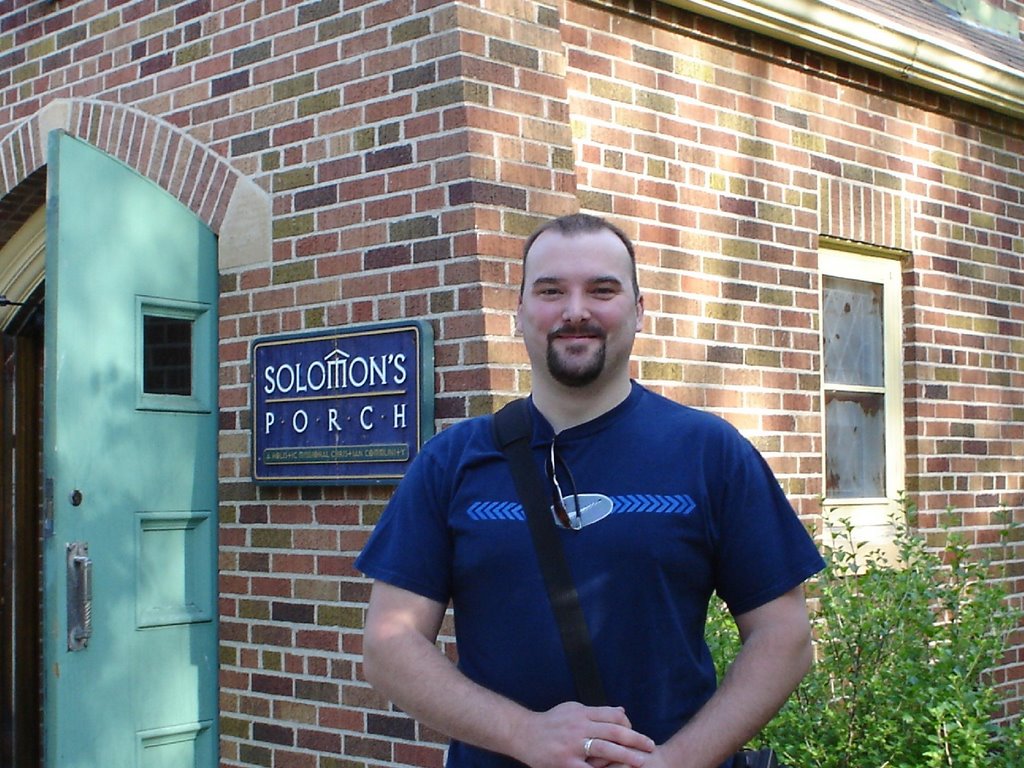
Solomon's Porch currently meets in a rented out old United Methodist Church building. Of course, this is me.


And this is my best friend and co-traveler to the Summer Institute, Jared Coleman (with his ever-present iBook).


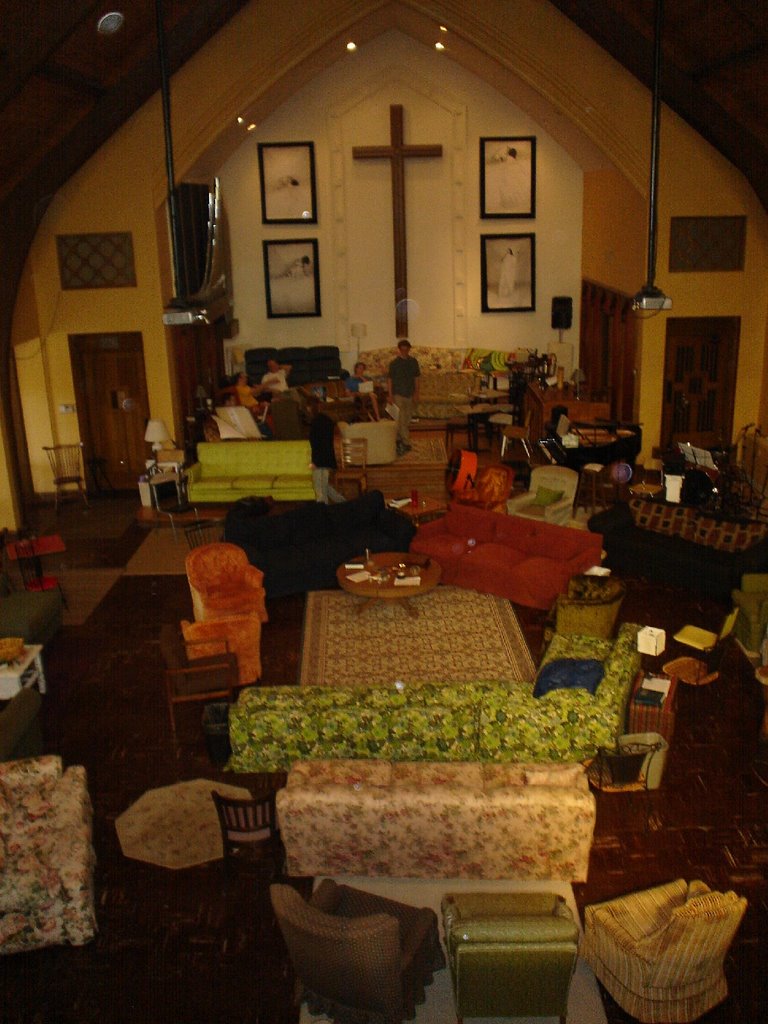
One of the things that I became aware of was the concept of implicit theology. Explicit theology is usually pretty easy to determine... it is the stated, obvious beliefs about God and our relationship to him. The implicit theology, however, is subtle, and most people overlook it, while absorbing it subconsciously. For example, as you can see, Solomon's Porch has a bunch of couches, arm chairs, bistro sets, coffee tables, sofa tables, etc in their main "auditorium"... or, the Great Room, as they call it. It was amazing to realize what this arrangement says implicitly about how "church" should be. Church, for this group, is not about some holy, sacred, formal, "special" place where we come to worship; worship should be a part of our everyday lives. The living room atmosphere conveys that when they are together, it is just an extension of their everyday lives. It also stresses the idea of community, particular of family. How different from traditional church arrangements, eh?


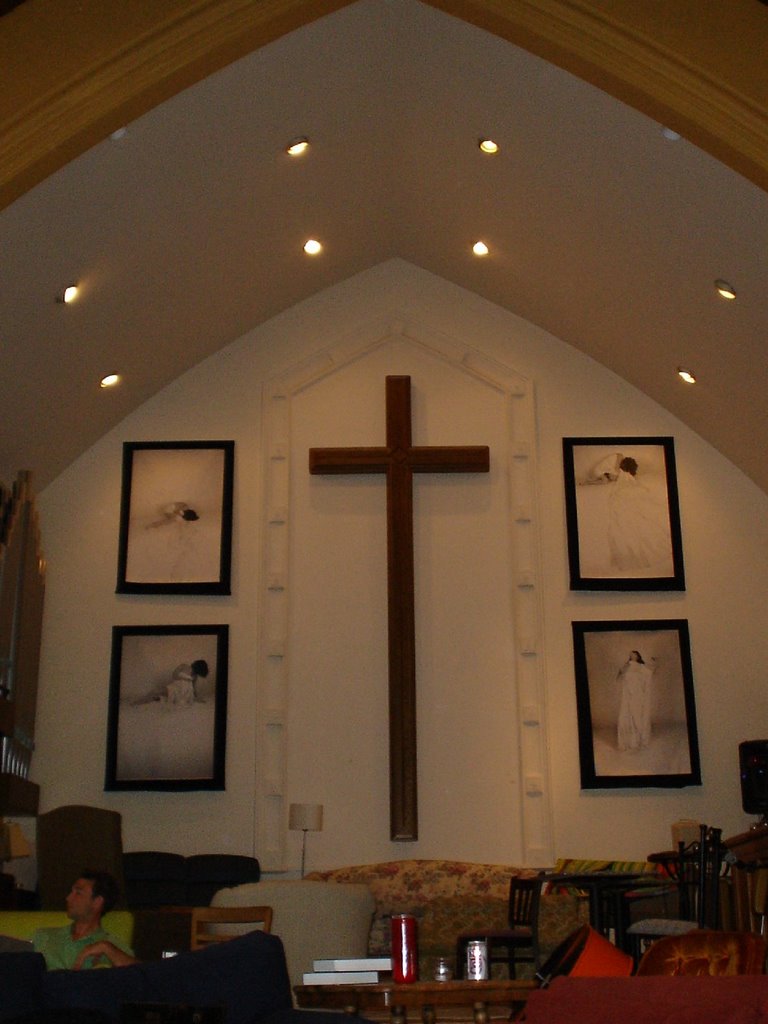
In the area that was once the front area, they left the cross, but used some artistic photography by one of the community members to visually display the transformation at the cross. Controversial... yes. Powerful... absolutely. (I highly recommend going to the community's website and going to the gallery section; there you can see more examples of the art there as well as learn more about the artists). Such prominent display of artistic expressions conveys that this is a place were creativity and multiple voices are appreciated.


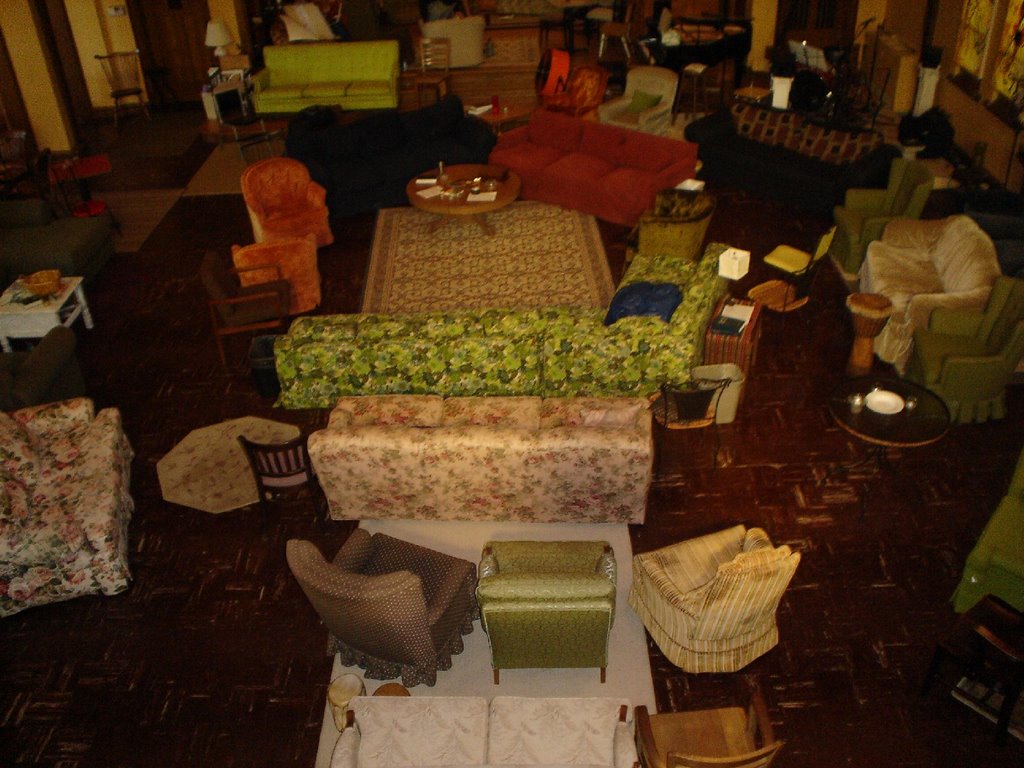
Another view of the central area. The "preaching", really, teaching, is given from a stool in the center. Again, the implicit theology behind that could be that no one is more important than another before God, and therefore should be down equal with everyone, not raised like a deity on a platform. They also try to avoid using microphones, at least individual ones, because when only one person has a mic, it implicitly tells you that your voice is unimportant or irrelevant, and only that one person using the mic is important. I never thought about what our environment says about our "theology." It certainly makes me understand the importance of the tabernacle and temple, in terms of the details.

As I understand it, kids stay active in the community, and only leave for "classes" during the sermon. As you can see, such a set up implicitly shares the value of children and the integration of children in community life.


Of course, what would a creative, missional, Christian community be in a late modern, post Christian context without wifi (which Jared -and I- took full advantage of)?

Thursday, June 22, 2006

Sidenote: New Hampshire Trip

At the end of May, I had the opportunity to go to a friend's wedding in New Hampshire. You can see these pics and the entries at my other blog, lifeoftonyh.blogspot.com. Why, you may ask, would I have two blogs?

The answer is actually very simple, and yet nuanced. You see, I'm using this blog to share my spiritual journey, as well as life journey, since they are intertwined. However, some of my dearest friends and families would not understand some of my spiritual musings or activities... so it is easier to share my basic activities with all my friends and family on one blog, and my more... unorthodox journies on another. Such is my life. I don't want to seek strife; I won't hide where my spiritual journey is going, but I'm kind of employing a "Don't ask, don't tell" policy. If certain friends and family ask questions, I answer vaguely, and so far, they haven't asked further so I haven't had to tell, and the relationships can continue unhindered. I'm not sure if it is the "best" policy, but it is working for me right now.